A patent application containing a written description of the invention sufficient to enable one of skill in the art to practice the invention without undue experimentation (the “specification”), typically one or more drawings, and one or more claims are filed with the United States Patent and Trademark Office ("USPTO").
The application is first examined as to form and completeness, and the application is then passed to a USPTO Examiner who examines the application for substantive compliance with Title 35 of the United States Code. The Examiner, who typically has a science or engineering degree, and may (but is not required to) hold a law degree, studies the application and conducts a search of the prior art. The results of the Examiner's search are communicated to the applicant in writing in the form of a so-called “Office Action.”
Typically, a PTO Examiner will reject patent claims as “anticipated” under §102, and/or as “obvious” under §103, based on the prior art search. This rejection starts a process of negotiations between the Examiner and the applicant (or his attorney). The applicant then files a response or an “Amendment” in which the claims (1) may be amended, typically by the addition of one or more limitations, or (2) canceled in favor of new, narrower, or more limited claims. Technical arguments are also presented urging a basis for why the new, more limited claims are not anticipated by or obvious from the prior art. The Examiner may (1) maintain the original rejection, (2) conduct a further search and issue a further Action rejecting the claims based on the further search, or (3) allow the application.
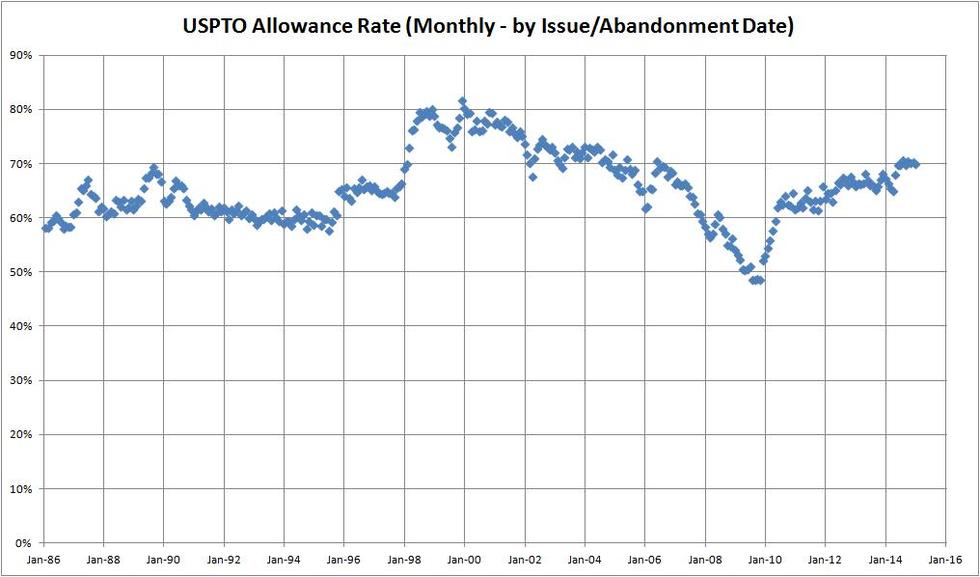
The examination process is analogous to a contract negotiation. The Applicant begins the negotiation by filing a patent application with claims which define the “offer.” The Examiner, after conducting a prior art search, may accept the “offer”, or the Examiner may reject the “offer”, e.g. for the reason that the claims do not meet the “novel/nonobvious” criteria of §§ 102 or 103. In essence, the Examiner rejects a claim “offer” as “too high” or “too broad.” It is then up to the applicant to come forward with a new, lower (more narrow) “offer” which typically takes the form of (1) an Amendment in which the claims are narrowed or restricted, or (2) a new application with more restricted or narrower claims. The Examiner may (1) accept the applicant's new “offer”, or (2) reject the claims again, or (3) make a “counter-offer” suggesting more restricted or narrower claims which would be allowable. Unlike conventional contract negotiations which are integrated into the written contract, the proceedings or prosecution in the Patent Office remains available to interpret and limit the patent. This is known as the “file wrapper” or the “prosecution history.”
In building a patent portfolio a company must make several business determinations including: (1) determine the importance of each technology to its business in each country; (2) the value that a patent would have; and (3) the risks of not having that particular patent. These decisions must be made early in order to protect the company's rights in ideas and developments related to new and improved products and processes. Early decision-making also provides the maximum number of options for protecting the new product or process.
Look at our results.